

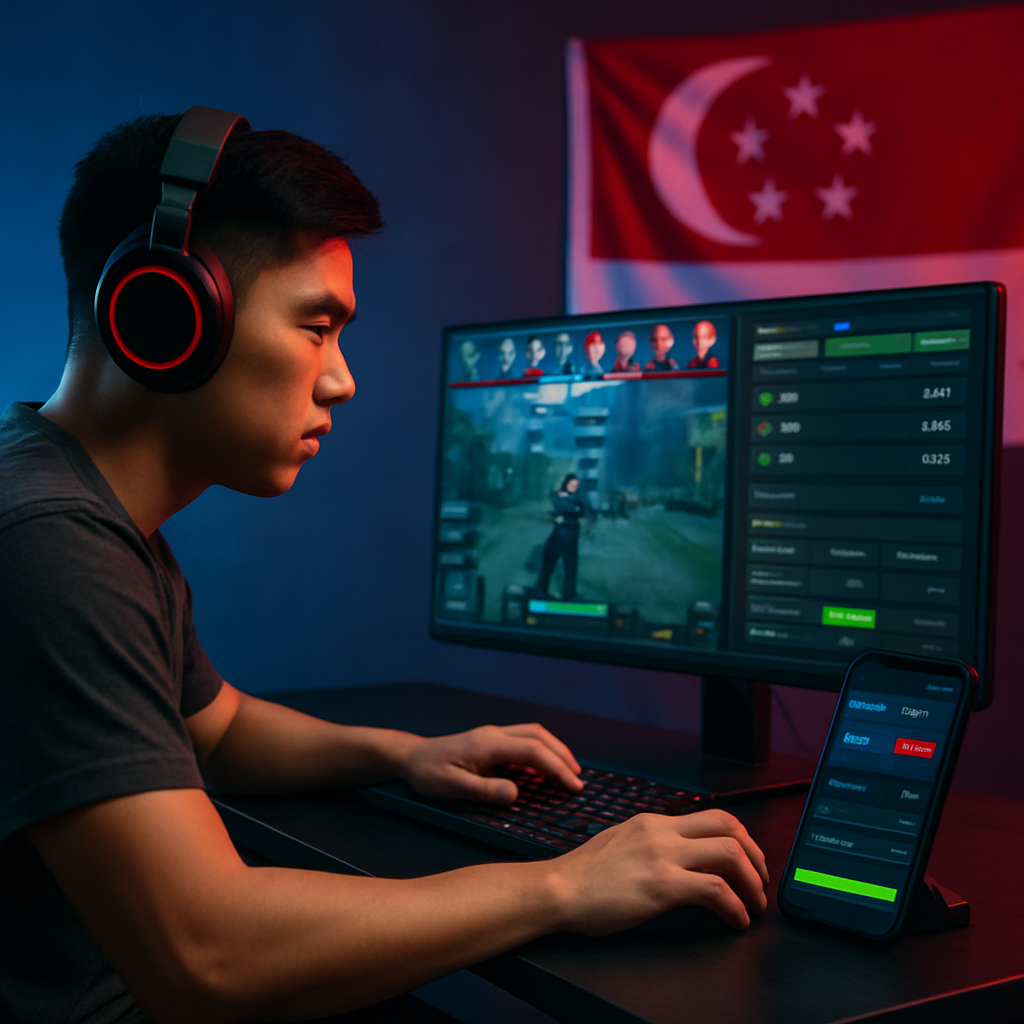
How to Bet on Esports: A Step‑by‑Step Guide for Singapore Gamers
Want to bet on esports from Singapore without getting blindsided by legal, payment or volatility pitfalls? This step-by-step guide shows how to pick a secure esports betting site that supports SGD and mobile, explains common markets and odds across Dota 2, League of Legends, CS:GO and Valorant, and walks through account setup, live betting tactics, staking strategy and withdrawals. No hype – practical checks and examples you can use before placing real-money bets.
1. Understand the legal and regulatory landscape for Singapore players
Immediate point: Remote gambling is tightly regulated in Singapore, and that reality changes how you should approach any operator before you bet on esports. The legal framework does not automatically bar individual bettors from using offshore sites, but it creates practical risks around payments, dispute resolution, and enforcement.
How the law matters in practice
Regulatory source: The Gambling Regulatory Authority manages guidance under the Remote Gambling Act; read the primary material at GRA and the statutes on Singapore Statutes Online. These pages explain what operators and gamblers can expect from a legal standpoint and are the starting point for due diligence.
Offshore license tradeoff: Many esports betting sites use a Curacao license. That gives operators commercial flexibility and often deeper esports markets, but it also means limited local consumer protection for Singapore players. Disputes are typically handled under the operator jurisdiction or private arbitration, not by Singapore regulators. See Curacao eGaming for registry checks.
- Checks to run before you deposit: verify the license on the operator website and cross-check the registry, confirm the legal company name and country of incorporation, and test customer support response time.
- Payment and payout considerations: prefer platforms that publish clear payout windows and support e wallets or SGD accounts – banks sometimes reverse or block transfer to offshore merchants.
- Dispute and T and C clarity: read settlement rules, bonus rollover terms, and account suspension clauses; these are where players lose claims in practice.
Practical tradeoff: Operators with deep esports markets and attractive odds often accept Singapore players and offer SGD support, but accepting those features increases your reliance on the operator for fair treatment. If a large withdrawal is disputed, expect slow resolution and limited local recourse – you will be negotiating with an offshore business, not appealing to a Singapore regulator.
Concrete example: A Singapore bettor placed SGD 2,000 on a Dota 2 outright at a Curacao-licensed site and won. The site flagged the payout for additional KYC and delayed payment for three weeks; contacting the local regulator produced no immediate remedy because the operator is offshore. The practical lesson is to test a new account with small deposits and check documented payout timelines before scaling stakes.
Common misjudgment: Players assume a license equals protection. In reality, licensing jurisdiction matters – a license from a small offshore regulator is not a substitute for transparent dispute mechanisms, published proof-of-settlement rules, and reliable payment rails. Do not conflate flashy esports markets with consumer safety.
Next consideration: If the legal signals are acceptable, proceed to platform selection with attention to SGD support, mobile UX, and quick payout proof – those operational details matter as much as the license itself when you place real money esports bets.
2. Choosing the right esports bookmaker: what to check and platform comparison
Key selection principle: pick the bookmaker that matches the markets you actually use, not the flashiest promo. Odds and market depth for the titles you follow determine long-term returns; bonuses matter only if the wagering requirements and withdrawal rules are sane.
What to check — objective criteria
- License & dispute route: confirm the operator shows a verifiable license and clear dispute channels (for offshore sites check the licence page and register on Curacao eGaming).
- Odds competitiveness: compare implied probability across 2–3 sites on the same match — small edges compound fast in esports.
- Market depth and special markets: ensure map bets, first blood, player props or region-specific markets (e.g., Mobile Legends) are available for the tournaments you target.
- Liquidity & limits: check maximum stakes and how odds move during live play — low liquidity means volatile swings and bigger slippage.
- SGD support & payment rails: prefer platforms that accept SGD or local e-wallets to avoid conversion fees and withdrawal headaches.
- Mobile UX and live betting latency: test the app or mobile site in a live match; slow refresh kills in-play value.
- KYC, withdrawal terms and bonus T&Cs: minimum withdrawal, processing time, and rollover rules must be readable before you deposit.
Practical trade-off: there is a consistent trade between recourse and pricing. Offshore operators often post deeper esports markets and competitive odds, but you accept weaker local consumer protections. Regulated operators may be slower on niche esports markets and offer poorer odds, but dispute resolution is clearer.
Platform comparison snapshot
| Operator | Esports focus / markets | Odds quality | SGD & mobile | Regulatory note |
|---|---|---|---|---|
| GGLBET | Esports-first: Dota 2, LoL, CS:GO, Valorant, Mobile Legends | Competitive on mid/high-tier events | SGD support and mobile-first UX | Curacao license; check T&Cs and dispute route |
| Rivalry | Strong esports catalog, social features | Good for public markets, occasional limits | Mobile app, SGD varies by region | Offshore/varies by market |
| Pinnacle | Selective markets but deep liquidity | Often best odds and high limits | Limited SGD support; web-first | Well-known operator; regulated in multiple jurisdictions |
| Bet365 | Huge market breadth, including esports | Solid odds but not always best for esports | Excellent mobile apps; SGD availability varies | Major regulated operator in many countries |
| Loot.bet | Esports-focused, many niche props | Competitive on niche markets | Mobile-friendly; SGD support limited | Offshore licence; check protections |
Concrete example: If you want to bet on a SEA Dota 2 qualifier Best-of-3, GGLBET may offer map-by-map markets with SGD deposits and fast cashier processing, making quick line shopping practical. Pinnacle might quote slightly sharper odds but only in USD and with higher minimum stakes, so your choice depends on whether raw edge or currency convenience matters more to your strategy.
Judgment that matters: for Singapore players focused on frequent, mobile in-play bets, a mobile-first, SGD-capable operator with decent market coverage — even if offshore — is usually the pragmatic choice. For larger, infrequent bets where margin matters most, prioritize operators with the best odds and deepest liquidity, accepting the extra work on currency conversion and withdrawal routing.
Next consideration: after you pick a bookmaker, run a short live test: place a small pre-match and a small in-play bet to check odds movement, cashout behavior and settlement speed before allocating real bankroll size.
3. How to create an account, deposit in SGD and complete KYC
Start correctly: register with your real name, a working phone number, and a valid email. Choosing the currency as SGD during registration or on the cashier page matters more than you think – it prevents surprise conversion fees and slower bank routing.
Step-by-step checklist
- Register: complete the sign up form and verify email and phone via OTP.
- Set currency to SGD: check the cashier or account preferences and lock it in before your first deposit.
- Deposit method selection: pick card, local bank transfer, e-wallet, or crypto depending on speed and fees.
- Upload KYC docs: government ID, proof of address dated within 3 months, and proof of payment if asked.
- Enable security: turn on two factor authentication and add a recovery email or phone.
- Keep records: save screenshots of deposit receipts and the transaction ID for at least 30 days.
Concrete Example: a Singapore player opens an account at an offshore esports bookmaker. They choose SGD at the cashier, deposit SGD 150 via an e-wallet, and immediately upload a photo of their NRIC and a recent bank statement. The platform clears KYC in 24 hours and the funds appear in their betting wallet ready for live esports betting.
Practical trade-off: cards and e-wallets are fast for deposits but often require withdrawal back to the same instrument, while bank transfers can be slower and trigger extra verification. Crypto moves quickly and avoids FX, but creates volatility and fewer dispute remedies with offshore operators.
| Method | Typical speed | Typical fees | Notes |
|---|---|---|---|
| Visa / Mastercard | Instant deposit, 1-5 business days withdrawal | Low to medium | May require card scan for KYC; withdrawals often to the same card |
| E-wallets (Skrill, Neteller) | Instant | Low | Fast deposits and withdrawals but check wallet-to-wallet limits |
| Bank transfer | 1-3 business days | Low | May trigger proof of funds; useful for larger amounts |
| Cryptocurrency | Minutes to hours | Network fees | Fast and private but price volatility and limited recourse |
Common KYC pitfalls and how to avoid them
- Mismatched addresses: ensure the address on your proof of address matches profile details exactly – small differences slow verification.
- Low quality uploads: use clear, uncompressed images or a single PDF; blurry photos cause rejections and delays.
- Wrong document types: if a statement is older than 3 months it will be rejected – check the platform requirements first.
If the platform requests proof of payment, send it proactively. That single step cuts average verification time from days to hours during tournament peaks.
Final judgement: expect KYC holds and method-matching rules with reputable offshore bookmakers – they protect you and them. Plan deposits before live matches, keep clear documentation, and prefer methods you can withdraw to without extra verification steps.
4. Esports markets explained with concrete examples
Key point: Esports markets are more granular than traditional sports — title mechanics, match format and patch meta change how you find value. Treat market selection as a toolkit: pick the market that matches your edge, not the market with the loudest odds.
Common markets and short, practical definitions
- Match winner: The team that wins the overall fixture. Use for outrights on Bo3 and tournament bets.
- Map winner / map handicap: Winner of a specific map or a +/ – map spread. Useful in CS:GO and Valorant where teams have map pools.
- Total maps / correct score: Number of maps played in a match, e.g. 2-1, 2-0 in Bo3. Less volatile than single-map outcomes in some matchups.
- First blood / first blood player: Early-game prop found in LoL and Dota 2; high variance but clear edge when one team drafts aggressively.
- Total kills / player kills: Over/under on kills or player stats. Requires granular in-game data — consult Dotabuff or OP.GG.
- Outrights: Tournament winner or stage winner. Low frequency, long-term hold on bankroll.
Concrete Example: CS:GO map winner on Dust2. Bookmaker A lists Team Red at 2.25 to win map 1. Implied probability = 1 / 2.25 = 44.4%. If your analysis (demo reviews, HLTV form) gives Team Red a 50% chance on Dust2, that price contains value and is worth a small, measured stake.
Odds math example: Dota 2 total kills Over 55.5 at 1.80. Implied probability = 55.6%. If you estimate the true chance at 60% after checking patch impact on team tempo via Dotabuff, edge = 4.4%. With a 1,000 SGD bankroll and 1% unit sizing, stake = 10 SGD; this is a value bet, but modest because margins and variance are high.
Live prop example: Valorant first blood. Odds 3.00 on Player X to get first blood. This is a high-variance prop — favour it only if Player X is known for aggressive entry plays on the map in question. Reduce stake size compared with match bets; treat as situational, not a core staking unit.
Practical trade-offs and what bettors miss
- Best-of-1 vs Best-of-3: BO1s are lottery tickets. Reduce stake or avoid for bankroll preservation. BO3 spreads out variance and lets skill show.
- Map bets reduce noise: If you know a team bans or favors a map, map markets are the place to exploit that niche knowledge.
- Player props = liquidity and margin risk: Props often carry wider margins and thinner books; small edges evaporate quickly and settlement disputes happen more often.
- In-play pricing is noisy: Live odds can lag after tactical pauses or roster swaps. Use live only when you can access reliable streams and fast mobile execution.
5. Staking plans and value betting for esports
Bottom line: how you size bets determines whether your edge survives variance. In esports, short formats, small markets and patch-driven meta shifts amplify variance, so staking discipline matters more than picking a favourite.
Core staking frameworks and when to use them
Practical options: Use a flat stake for simplicity, a percent-of-bankroll model for proportional risk control, or a unit system where 1 unit = 1–2% of bankroll. The Kelly criterion works on paper but fails in practice unless you have persistent, well-calibrated edges and can tolerate large variance swings.
- Flat stake: same amount every bet. Good for learning and preventing overconfidence.
- Percent staking: scale bets as bankroll changes; use 1–2% per standard bet in esports because of high volatility.
- Unit system: define 100 units, bet 1–5 units depending on confidence; reduces emotional overbetting.
- Kelly (fractional): only for advanced bettors with a proven edge and reliable probability model — otherwise use fractional Kelly (e.g., 0.25 Kelly) if you must.
Value identification: convert odds to implied probability and compare to your estimate. Line-shopping across operators — including GGLBET, Pinnacle and Bet365 — is where most real value shows up. Esports markets are thinner than football: a few percentage points of better odds can be decisive over months.
Concrete example: you see a Dota 2 match where GGLBET shows 1.85 for Team A (implied probability 54.1%). Your model, using Dotabuff and recent patch performance, estimates Team A at 65%. That 10.9-point edge is value; with a 2% bankroll rule on a $1,000 bankroll, you stake $20. If you used full Kelly here you might stake far more and blow variance — so fractional approaches are safer.
Live betting trade-offs: reduce stakes for in-play bets because odds move faster and information arrives asymmetrically. Prefer live bets on clear tactical cues you can verify (player substitution, map veto news, connection issues) rather than pricing momentum or crowd noise.
- Hard limits: set a session loss cap (for example 5% of bankroll) to stop tilt.
- Max exposure: never risk more than 5 units on a single event; drop to 1–2 units for Best-of-1s or low-liquidity markets.
- Avoid correlated parlays: combining markets from the same match multiplies risk and masks true edge.
6. In play betting, live data and tools that matter
Live value is a timing game. In-play markets move faster than prematch lines and the single biggest edge is having the right data feed faster than the book. If your stream, mobile connection or odds feed lags by even 10–20 seconds you will consistently lose to sharper players and automated trading engines.
What data streams actually matter
Priority sources: use event tickers and official tournament feeds first for state (round, map, pause). Supplement with focused stats sites for context: HLTV for CS:GO form and round history, Dotabuff for Dota 2 match pace and hero trends, and OP.GG for League of Legends and Valorant player stats. Relying on a public Twitch stream alone is a poor substitute because of variable delay.
- Essential: official match scoreboard/ticker (lowest delay) — verify before betting live
- Context: HLTV / Dotabuff / OP.GG for player form and map histories
- Odds layer: live odds comparison across bookmakers to detect stale pricing — use at least two sources including your main bookmaker (for example GGLBET)
- Execution: mobile app with fast cash-out and low latency websocket feed when available
Trade-off to accept: speed versus certainty.** Faster feeds get you better prices but come with less time to interpret events. If you chase every swing you amplify variance. Successful live bettors narrow the markets they follow and accept smaller, more frequent stakes.
Concrete example: In a CS:GO BO3, a bomb defuse bug creates a 40-second technical pause. Live odds will often overreact — map and match lines skew toward the team that was winning momentum. A practical response is to shrink stake size or hold until the official scoreboard confirms resumption; using HLTV's live round log and the bookmaker's live market together exposes mispriced lines caused by fragmented information.
Common failure mode and solution: bettors watch a delayed stream, see a clutch play, and instantly place a large wager. The market has already priced that event. Solution: trade only on objective state changes (round score, timeout, player disconnect) visible in a low-latency ticker and predefine rules to adjust stake sizes on those states.
Practical checklist before placing an in-play wager: 1) Confirm official match timer/ticker, 2) Cross-check live odds across your main bookmaker and one alternate, 3) Reduce unit size for fast-react markets (first blood, pistol, round winner), 4) Have cash-out thresholds and abort rules for pauses or disconnects.
Next consideration: set explicit live-betting rules in your staking plan — which markets you will play, maximum percent of bankroll per live event, and how you respond to technical pauses.
7. Withdrawals, dispute resolution, taxes and responsible gambling
Clear expectation first: withdrawals take time and documentation is the norm, not the exception. Expect an initial KYC hold, a platform processing window, and then the payment rail delay depending on method. Plan bankroll access around those timelines.
Withdrawal mechanics and real trade offs
Timing and method: e wallet withdrawals usually clear in 24 to 72 hours, card and bank transfers take 3 to 10 business days, and crypto can be near instant but with on chain confirmation waits. Trade off: crypto speeds up cash out but reduces chargeback and legal recourse if something goes wrong.
Documentation matters: platforms will ask for government ID, proof of address and sometimes proof of source of funds for larger wins. Keep deposit receipts, transaction IDs and screenshots of bet slips. These are your primary evidence if a payout stalls.
Disputes and realistic escalation routes
Start with support and timestamps: open a support ticket, include bet reference numbers, timestamps, match stream links and transaction IDs. Always request a ticket number and use the platform chat log or email as the official trail.
- Step 1: Provide clear evidence and request estimated resolution time from customer service
- Step 2: If unresolved, escalate with screenshots to the operator compliance team and reference the operator license page on their site
- Step 3: For offshore licensed operators, file complaints with the license authority such as Curacao eGaming while keeping expectations modest about enforcement speed
- Step 4: If you used a card, consider a chargeback as a last resort and note timing and grounds required by your bank
Practical limitation: playing with a Curacao licensed operator gives you less local legal protection than a locally regulated provider. That is not a reason to avoid offshore operators, but it is a reason to keep excellent records and to prefer SGD supported rails to reduce conversion disputes.
Concrete example: A Singapore player withdraws SGD 2,000 after a Valorant tournament bet. The site places a 48 hour KYC hold and asks for proof of address. The player supplies documents, records the support ticket, and receives the e wallet payout in 36 hours. When a second withdrawal stalled later, the player used transaction IDs and the earlier ticket to escalate and received a manual release within five days.
Taxes and responsible gambling obligations
Tax reality: casual gambling winnings are generally not taxed in Singapore, but repeated professional style activity can attract tax treatment. Keep records and consult a tax advisor if your activity looks like business income rather than hobby income.
Responsible controls that work: set deposit and loss limits, use session timers, enable reality checks and self exclusion where available, and test how the platform enforces limits before you place large wagers. Offshore operators may not integrate with Singapore self exclusion schemes, so self management is critical.